Use Cases · Coordination Validation
Coordination judged against the requirement, not just the geometry.
Requirements are organised by discipline, then the model, the drawings, the documents and the incoming submissions are reviewed against them and against each other. Geometry is one input. The disagreement between the four is usually where the problem lives, and coordination failure is the dominant cause of error on multi-discipline work.
- Cross-discipline coordination
- Interface and package conflict
- Clash detection
- Spec to drawing
- Submittal and shop drawing review
Riser 03 · clear widthRev C
One dimension. Four sources. Three of them agree.
Model
800
Drawing
800
Specification
1000
Submittal
800
200mm of maintenance access, specified once and lost three times over. Nothing intersects, so no clash report mentions it.
Current practice
Clash detection sees geometry. The failures that reach site rarely are.
A clash report tells you where two solids intersect. It is fast, mature and largely solved. What it cannot see is a specification that says something different from the drawing, a subcontractor delivering to the model rather than the intent, or a design change that quietly broke a requirement agreed in a meeting four months ago.
Those are the ones that reach site, because nothing in the coordination process was looking for them.
- Volume without priority, so the real conflicts sit inside thousands of resolved intersections
- Requirements that live in correspondence are invisible to a geometric review
- Incoming submittals are logged as received rather than reviewed against the intent
- No single place says what each discipline owes, or whether it has been examined
What each discipline pair is examined for
- Upper half: geometry, examined on every pair
- Lower half: the requirements that govern the pair, examined on none
With Tektome
One status, per discipline, against what they actually owe.
Requirements are organised by discipline, so what each one must deliver is explicit and tracked. The review then runs across the model, the drawings, the documents and the incoming submissions together, against those requirements and against each other. What comes out is a position you can put in front of a client, an insurer or a claimant.
Structure42 requirements
Structure ↔ Mechanical
Riser clear width. Specification says 1000mm for maintenance access, the model and drawing carry 800mm. Nothing intersects, so no clash is reported.
Mechanical67 requirements
Mechanical ↔ Electrical
Containment above the compartment line. The route satisfies every requirement and is not buildable in the stated sequence. Referred to a person rather than settled.
Electrical38 requirements
Electrical ↔ Fire
Penetration sealing schedule. Waiting on the specialist. Both disciplines are complete on their own side, and the interface cannot be settled until it arrives.
Fire29 requirements
What you get
The outputs, and the evidence behind each one.
Requirements organised per discipline, and per interface
Extracted, structured and tracked as the project moves, so what each discipline must deliver is explicit rather than assumed. Requirements shared by two disciplines are held on the interface itself, with an owner, rather than being assumed by both and delivered by neither.
Why it mattersA requirement inside one discipline has an owner by default. A requirement between two does not, and that is the one that reaches site.
Shared across an interface · 227 tracked
Structure ↔ Mechanical
14 shared · 2 open
Mechanical ↔ Electrical
21 shared · 1 open
Structure ↔ Facade
18 shared · settled
Electrical ↔ Fire
9 shared · waiting
Mechanical ↔ Fire
12 shared · settled
Cross-discipline, cross-format review
Model, drawing, document and specification reviewed against the requirements and against each other. Drawing against specification, specification against schedule, schedule against model, so a disagreement between two accounts of the same thing is surfaced rather than assumed away.
Why it mattersMost coordination failures are contradictions between formats, not intersections within one of them.
Agreement matrix · services package
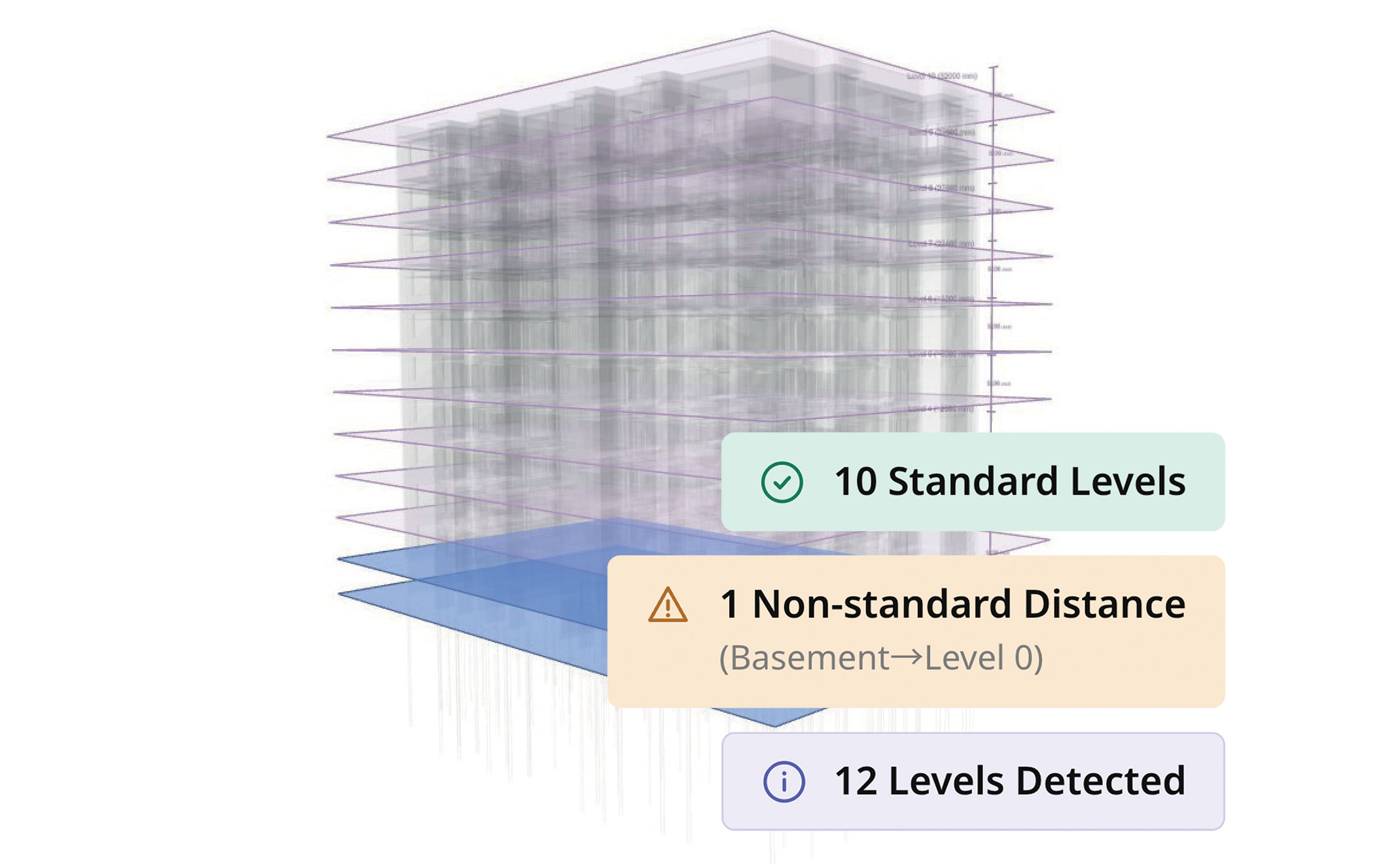
Clash and alignment detection, with model data validation
Geometric review is still there, and it runs alongside alignment detection and model data quality validation. What changes is the triage: conflicts are ranked by the requirement they threaten rather than presented as an undifferentiated list.
IncludingHard and soft clash, setting-out alignment, naming and classification validation, missing or malformed parameters, and duplicate or orphaned elements.
Level validation · 12 levels detected
Incoming submissions reviewed, not just accepted
Submittals and shop drawings are reviewed against the design intent and the requirements they have to satisfy, before they are accepted. A fabricator following the model rather than the specification is caught at review, not at delivery.
Why it mattersA submission accepted on receipt transfers the error into fabrication, where it stops being a drawing problem.
Where the intent was lost
Specified
1000mm clear width, maintenance access
Modelled
800mm, void depth taken from the ceiling zone
Submitted
Fabricator took the dimension from the model
Held
Returned with comments before release to fabrication
Version control and one source of truth
Models, drawings and information are versioned together, so what changed between two issues is a question with an answer. Coordination status is held against the current revision rather than whichever file someone opened.
Why it mattersHalf of coordination arguments are two people looking at different revisions and both being right.
Version control · detected changes
Rev 2 → Rev 3
Compared 12 Aug
Comparison complete
Added
Missing soil vent pipe added to three rooms
Removed
Internal wall between kitchen and living room removed
Modified
Window width increased by 27.7%
Affected
Four room areas reduced by the change above
3
Added
Missing soil vent pipe
1
Removed
Internal wall
1
Modified
Window width, +27.7%
4
Affected
Room areas reduced
Added
Missing soil vent pipe added to three rooms
Removed
Internal wall between kitchen and living room
Modified
Window width increased by 27.7%
Affected
Four room areas reduced by the change above
DrawingNo. A202
Live coordination dashboard
Status against the technical criteria: what each discipline must deliver, when a requirement changes, when a design breaks one, whether it has been achieved and how, and whether anyone has examined it. Items raised in a coordination meeting flow straight in rather than being re-typed afterwards.
Why it mattersCoordination changes every time a package moves, so a monthly report is out of date before it is read.
Tuesday's coordination meeting
Said in the room"Fine to drop the riser to 800 if maintenance are happy, but someone needs to confirm the spec still stands."
- Item
- Riser 03 clear width, confirm specification
- Interface
- Structure ↔ Mechanical
- Owner
- Mechanical lead
- Blocks
- Riser submittal, held
Reports to run the process, and the trail behind them
Coordination reports and meeting packs generated from the live position, in your own templates. Behind each one, the thread from requirement to review to resolution to the report it was issued in, all linked.
Why it mattersThe pack you take into a coordination meeting and the record you rely on afterwards should be the same thing.
Week 34 coordination pack · where each part came from
Open items by interface
From the live position
Riser 03, conflict and resolution
Spec §6.2 → rev C review
Actions carried from last week
Week 33 pack
Submittals held pending review
Submittal register
Every block traces back to the requirement it came from, so the pack you present and the record you rely on afterwards are the same object.
Value
What the work produces, what it prevents, and what that is worth.
45%
of projects affected by inaccurate, incomplete or late design, the single largest causal cluster
HKA CRUX, 6th annual report, October 2023 · 44.8% precisely; the design share has declined since
10%
of project value lost to avoidable error, with 77% of it by value traced to inadequate planning
CITB / GIRI Productivity Commission, April 2026 · 9.83% precisely, across 25 live UK projects worth £942.5m
33%
disputed costs as a share of contract budget
HKA CRUX, 8th annual report, to July 2025 · 33.4% precisely
Why Tektome
Geometric clash is solved. The interface between parties is where the duty sits.
Finding where two solids intersect is mature, fast and widely available, and we are not trying to win on it. The question a clash engine cannot answer is whether the coordinated design still satisfies what was agreed, across the drawing, the model, the specification and the submission at once, and which parts nobody has looked at yet. When that is disputed, a reasonable-steps defence is only as good as the record behind it.
| On this | A clash engine |  |
|---|---|---|
| The question it answers | These two elements intersect | Does the coordinated design meet the requirement |
| What it holds | Geometry, and nothing that lives in correspondence | The requirements, including the ones agreed in minutes and email |
| Formats read | The federated model, stopping where the specification begins | Drawing, model, specification and submittal, against each other |
| How it ranks | By volume and clearance, not by what the conflict threatens | By the requirement at risk, with the citation behind each finding |
| The uncoordinated | Says nothing about what has not been coordinated yet | Named, with the discipline that owes it |
Who this is relevant to
The interface is the same.
What it has to prove changes
with who is asking.
A coordination failure that reaches site was rarely anyone’s decision. It sat on a boundary between two parties and belonged to neither. The cost still lands on someone.
Legal and governance
General Counsel · Company SecretaryManaging Partner, Practice Director or Finance Director at design practices
A record of who agreed what
Every interface with a named owner and a dated decision, so a claim about coordination is answered from the record rather than from recollection.
Insurance and risk
Whoever owns the PI programmeThe title varies by firm; the renewal obligation does not
Evidence of cross-discipline review
Documented review across the model, the drawings and the specification together, rather than a clash report that speaks only for the geometry.
Design leadership
Technical Director · Head of Design ManagementBIM lead · Information manager
Triage that means something
Conflicts ranked by the requirement they threaten, with model data quality separated out rather than buried in the same list.
Delivery and packages
Project Manager · Package managerPrincipal Contractor, design coordinator
Nothing sitting between parties
A named owner on every interface, and shop drawings reviewed against the intent before they are accepted.
In the project team
Architect · Engineer · BIM coordinator. See which requirements a sheet carries and where two accounts of the same element disagree, in the tools already in use.
FAQ
Questions about Coordination Validation.
What is the difference between clash detection and coordination validation?
Clash detection reports where two solids intersect. Coordination validation asks whether the coordinated design still satisfies what was agreed, across the drawing, the model, the specification and the incoming submittal at once. A riser specified at 1000mm and modelled at 800mm produces no clash, because nothing intersects. Geometric clash is largely solved. The disagreement between formats is not.
What kinds of coordination failure does clash detection miss?
The ones that reach site. A specification that says something different from the drawing. A fabricator delivering to the model rather than the intent. A design change that broke a requirement agreed in a meeting four months earlier. None of these intersect anything, and requirements that live in correspondence are invisible to a geometric review, so nothing in the process was looking for them.
How can a drawing, model and specification be reviewed against each other?
By reviewing each against the requirement it has to satisfy, then against the other accounts of the same element. Drawing against specification, specification against schedule, schedule against model. Tektome surfaces the disagreement rather than assuming it away. Most coordination failures are contradictions between formats, not intersections within one of them.
Does this replace existing clash detection tools?
No. Geometric review still runs, alongside setting-out alignment and model data quality validation. What changes is the triage: conflicts are ranked by the requirement they threaten rather than presented as an undifferentiated list, with model data quality separated out rather than buried in the same queue. Finding intersections is mature and widely available, and Tektome is not trying to win on it.
How are shop drawings and submittals reviewed against design intent?
Against the requirements they have to satisfy, before they are accepted rather than on receipt. A submission accepted on arrival transfers the error into fabrication, where it stops being a drawing problem. Where a fabricator has taken a dimension from the model instead of the specification, the submittal is returned with comments before release, not discovered at delivery.
Next step
Interested to learn more?
A 30-minute session: a deeper look at the platform, and a conversation about the interfaces your firm is carrying between disciplines. Nothing to set up, no project data needed.
- One element followed across the model, drawing and specification
- A walkthrough on a project we have prepared
- Live Q&A with our engineering team
Book a 30-minute demo
Step 3 of 3
Pick a time with Henry
Thirty minutes, and you will get a calendar invite straight away.
Your meeting is booked.
A calendar invite is on its way to your inbox.
Henry will bring a prepared sample project, so there is nothing for you to set up.
Need to change it? Reply to the invite and we will sort it out.