
We started NEXUS because the change this industry needs will not happen one company at a time. Its second edition filled a room in Harajuku, Tokyo with 120+ people, four times last year’s turnout, and put some of Japan’s largest contractors and design practices on stage to show their peers how they are using Tektome platform.
Why we built NEXUS.
Tektome NEXUS 2026 was our second annual invitation-only gathering. The name Nexus means connection, and the bet we made when we created the event last year is that transformation on the scale this industry needs starts when the people driving it inside different organisations can compare notes directly. Our CEO Naoki Kitamura opened and closed the day. The rest of the stage belonged to our clients, which is the part we are most proud of. Five major Japanese contractors and design practices stood up in front of their peers to show how they are putting Tektome to work inside their own projects:
- Nishimatsu Construction Co., Ltd., Ryo Kanbe
- Obayashi Corporation, Yusuke Kusuda
- Hazama Ando Corporation, Go Watanabe
- Kume Sekkei Co., Ltd., Tomoyuki Furukawa
- Haseko Corporation, Daiki Hasegawa
Naoki’s two talks framed the day around them.
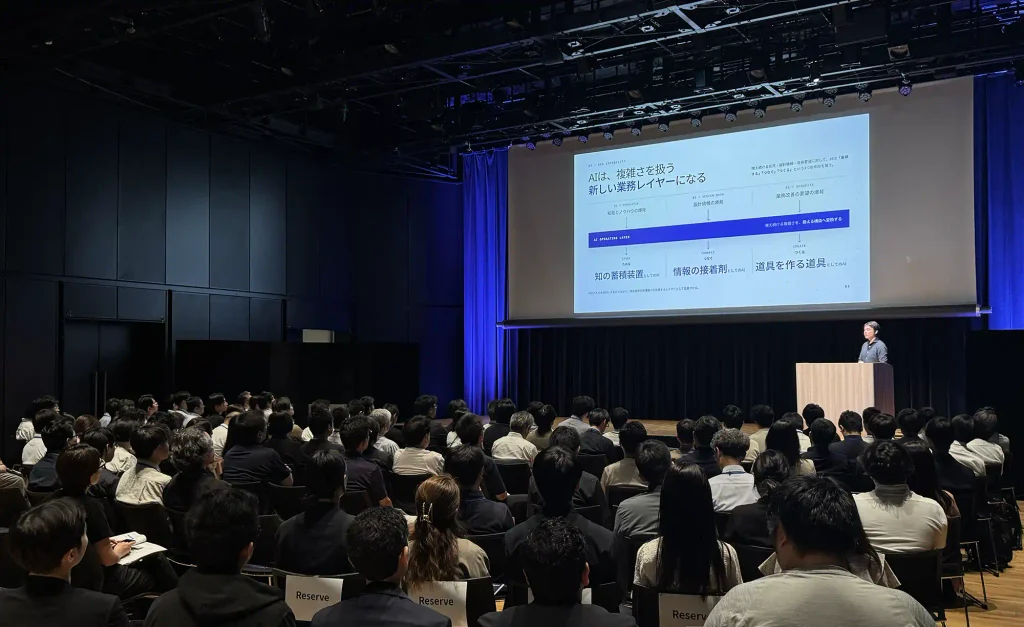
The main takeaways: three transformations, three uses of AI.
Naoki opened with three transformations he calls structural, meaning each needs a break from how the industry has worked for the last ten or twenty years rather than another round of small improvements. All three run into one constraint, an explosion of information. Veteran know-how no successor can absorb, design data reaching from 2D towards 4D and 5D, and improvement requests outpacing any central team. AI, on his framing, is not an automation tool here but a new operational layer, and it gets used three distinct ways.
| Transformation | How AI is used | What changes with AI |
|---|---|---|
| Passing on expertise | A store of knowledge: marked-up drawings, review comments, past defects | Expertise stops leaving with the person who held it |
| Expanding what BIM is worth | Connective tissue between the model, programmes, cost data and standards | BIM becomes something you think with, not something you look at |
| Efficiency across small, specialised tasks | A tool for making tools, built for the person in front of it | Improvement stops being rationed by IT capacity |
Why this changes the economics
The third carried the sharpest numbers. A workshop on where the pain is surfaces a hundred issues easily, but a twelve month build cycle means perhaps one per cent ever reaches deployment. A tool that once meant a two year programme and a budget in the tens to hundreds of millions of yen can now be described in a sentence and built in half a day, which is the only way that long tail gets addressed.
The drive is people and organisations.
The second half of the phrase “and what drives them” mattered more than the AI part. However good the models get and however clean the data, Naoki argued, the driver is still people and how they are organised. He put three shifts on the screen.
- Bottom-up over central planning. Rather than collecting requests upwards and distributing solutions downwards, let improvements appear where the work happens.
- Co-creation over delegation. Stop building on behalf of the person with the problem; support the person with the problem while they build it.
- Growth over completion. Instead of a year-long waterfall that finally produces something usable, make a small thing today, use it today, and grow it.
Three things then grow on their own. Organisations, as one person who solved their own problem becomes ten. Data, as it gets tidied where it is created rather than collected centrally afterwards. And the AI itself, because no off-the-shelf model arrives knowing how your organisation works.
What Multi Intelligence looks like.
The last section set out where the Tektome platform is heading. It has two layers. The visible one is the agent: you talk to it, and it reviews drawings and BIM models, searches large document sets, produces schedules, reports and charts, and builds applications on request. Underneath sits the intelligence foundation, which is the part that matters.
Without an intelligence foundation of its own, a company is just using the same AI as everybody else in the world, and there is no competitive advantage left in it.
Naoki Kitamura, CEO, Tektome
Multi Intelligence sits on top of that foundation: human expertise and AI agents sharing one ecosystem of knowledge and experience. On screen it is a graph, a user talking to an orchestrator ringed by eight specialist agents, each owning a domain such as regulations research or BIM review and wired to twins of senior colleagues and internal knowledge. A thousand people cannot train one AI, but ten can teach one agent properly. Power to the Architect was last year’s concept and the platform delivered it; Multi Intelligence sets the bar for next year.
What no single company can build alone.
Naoki’s closing talk stepped back from the platform to the industry. The pressures are familiar to anyone reading this from anywhere in the world: a shrinking skilled workforce, tightening regulation, and the prospect of running the same volume of work with roughly half the people, weighted towards the least experienced.
Against that, he cited research on where designers’ time goes. Around ten per cent is spent on work that creates no value and could be removed outright, such as hunting for information or correcting avoidable errors. The larger figure was starker.
Where design time goes
Share of a designer’s time, from research cited in the closing talk at Nexus 2026.
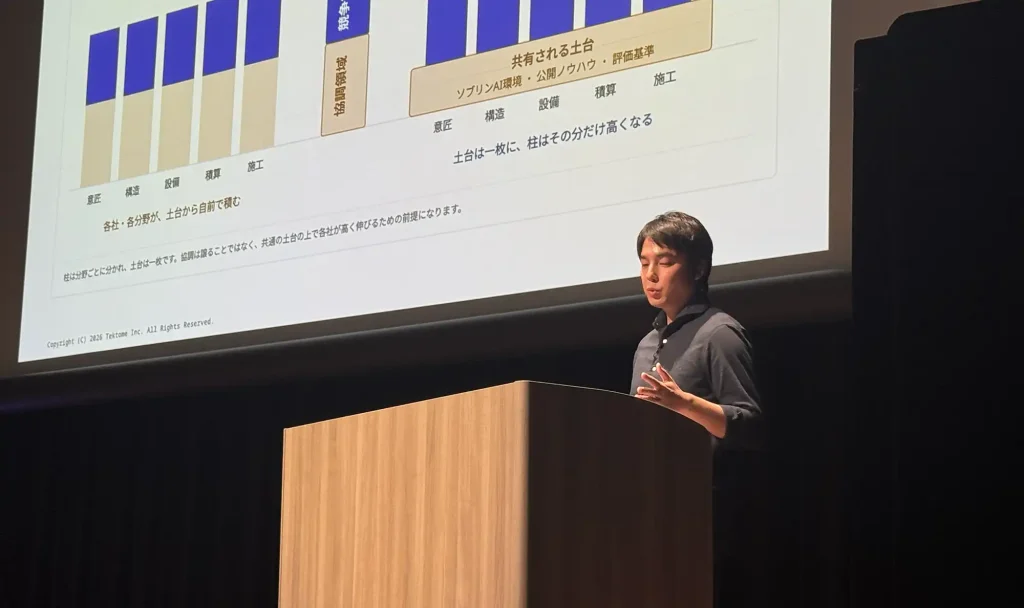
None of that is solvable by one firm alone, which led to the argument he chose to end the day on: the industry needs to be far clearer about where it collaborates and where it competes. If every organisation rebuilds the same foundations from scratch, roughly 80 per cent of finite investment capacity goes on work that creates no differentiation, leaving only the remainder for anything genuinely its own. Other industries have solved this. Semiconductor firms share research infrastructure, carmakers share software architecture and interface standards, finance shares API specifications, and all of them compete hard above that line.
Competition is built on top of collaboration.
Naoki Kitamura, CEO, Tektome
He did not announce a programme. He said plainly that he could have declared one and chose not to, preferring to leave the room with the question and propose it as a panel for next year.
Next year, in more than one language.
Nexus has roughly tripled in a year, and our ambition for the third edition is larger again, with live interpretation and guests joining from outside Japan as our overseas operations expand.
If you are running an AI or BIM programme and want to compare notes with the teams doing it here, we would like to hear from you.
See it on your projects
Tell us which review, regulation or handover problem you want to test, and we will set up a walkthrough on your own data and disciplines.