Starting a new building project is equal parts exciting and daunting. In those early concept meetings, architects and engineers are making big calls based on limited info which can feel like educated guesswork.
Wouldn’t it be nice to know that a proposed design will meet all the client’s requirements, stay on budget, and hold up to engineering scrutiny before you move forward? This is where agentic AI comes in.
In this article, we’ll demystify what “agentic AI” means in an AEC context, how it differs from the rule-based tools you might be used to, and how a whole team of AI “agents” can work together (like a swarm) to supercharge early design planning. The goal is simple: help you explore more options in less time, with solid data on every trade-off.
What is Agentic AI (and Why Should AEC Folks Care)?
“Agentic AI” might sound like jargon, but it essentially refers to AI systems that have a degree of agency – they can act autonomously to achieve goals. In practice, an agentic AI is like a smart digital assistant that doesn’t just wait for commands, but proactively helps with tasks.
For example, instead of you manually checking if a design meets code, an AI agent could decide on its own to run a code compliance check on your model, fix minor errors, or flag major issues – all without being explicitly told “check code X”.
Our white paper explains that unlike traditional chatbots or scripts, these autonomous agents can “plan tasks, call tools, verify results and act as proactive co‑designers rather than passive assistants.”
To clarify, this is different from the AI many firms have used until now. Older “AI” tools in design were often rule-based, essentially fancy if-then programs, or single-purpose algorithms. Think of a code-checking software that flags rule violations (but can’t do anything else), or a generative design tool that optimises a floor plan for daylight but doesn’t consider cost. Those tools are powerful, but they’re narrow.
Agentic AI, by contrast, is flexible and coordinated. It’s not limited to one domain; it can connect the dots between multiple tasks. It’s also not strictly pre-scripted – it learns and makes minor judgment calls. For example, if one agent finds a problem (say a structural issue), it could notify another agent or trigger a redesign task automatically. This kind of AI operates with a level of independence and teamwork that conventional tools lack. The payoff for AEC professionals is that a lot of the grunt work and analysis can be handled in the background, and you get actionable suggestions rather than just raw warnings or data.
Swarm Intelligence: AI Agents Working in Parallel
Now, imagine not just one AI helper, but a whole team of specialised AI agents working together on your project. This is the concept of swarm agents (or a multi-agent system). Each agent has its specialty, and they collaborate to cover the project from all angles – much like an interdisciplinary human team, but operating at digital speed. You could have:
- Architectural design agents generating layout options or tweaking the form.
- Structural analysis agents checking each option’s structural integrity (e.g. can the proposed cantilever work?).
- MEP agents ensuring HVAC, electrical, and plumbing schemes fit within the design.
- Cost estimation agents calculating budgets for each design variant on the fly.
- Compliance agents cross-checking building codes, client requirements, and standards against the design.
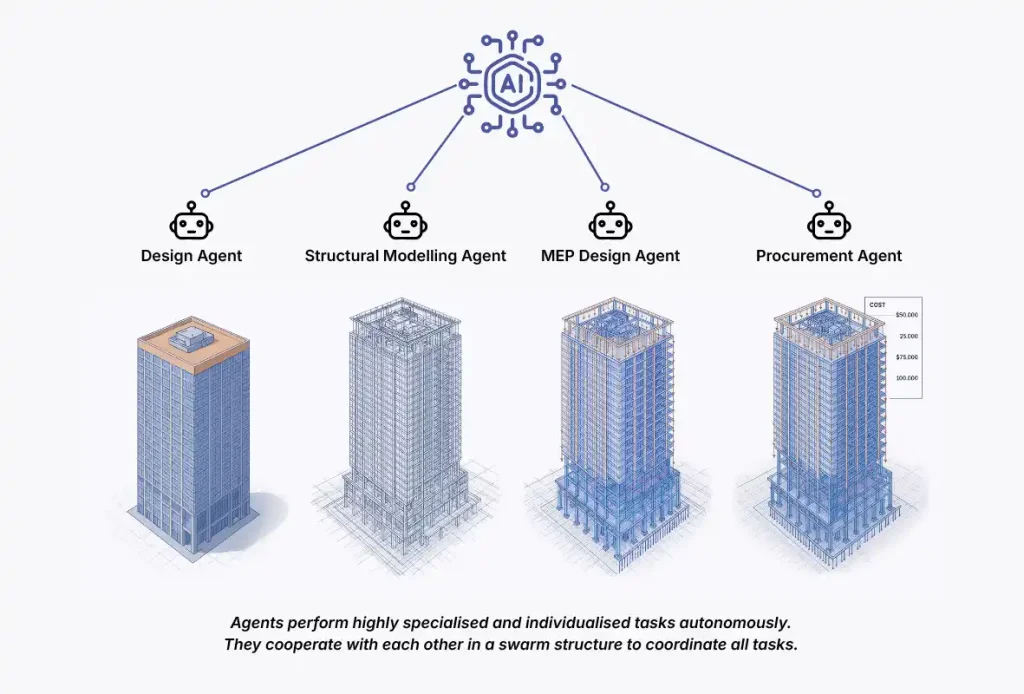
And here’s the magic – these agents don’t operate in isolation; they talk to each other. The speed and breadth of analysis here are unprecedented in traditional workflows. As an example, the Tektome paper notes that we can even imagine a design AI agent automatically engaging a structural analysis agent or a compliance agent within minutes when needed.
The result: what used to require sequential hand-offs and meetings could happen almost in real time. You get to explore many more “what if we did this?” scenarios in the concept stage, because the AI agents rapidly crunch through each scenario’s implications on cost, performance, and constructability.
Faster Trade-off Evaluation and Better Decisions
Traditionally, you might sketch a design and only find out later from the cost consultant that it’s 15% over budget, prompting redesigns. With an agent swarm, a cost agent is watching from the start, updating an estimate continuously. If you swap in a more expensive facade material, the cost agent will let you know in real time that you’ve exceeded the budget (and by how much).
Meanwhile, a performance or energy agent might tell you that the pricier facade significantly cuts energy use. All this information is surfaced early, so the team can have an informed discussion: is the trade-off worth it?
This goes for many trade-offs: structural robustness vs. material cost, architectural daring vs. code compliance, etc. AI agents essentially provide augmented decision-making. They do the heavy lifting of analysis, and present the pros, cons, and risks to you.
One of the best parts of this agent-based approach is how it reduces the iteration pain. In a normal project, each design revision can be slow and costly, because you need to loop in various specialists one after another. Here, the iterations are more like rapid-fire idea testing.
The “Brain” and “Rulebook” Behind the Agents
You might be wondering, how do these agents know what to do? The power of agentic AI comes not just from the algorithms, but also from the data and knowledge they’re given. In AEC, this means two things: knowledge of past projects (what worked, what didn’t) and the requirements/standards that the current project must satisfy. Tektome’s platform addresses this through two tools: KnowledgeBuilder and ReqManager. The white paper highlights these as the foundation that makes a multi-agent system effective:
- KnowledgeBuilder is essentially the collective memory. For our AI agents, KnowledgeBuilder is the rich database they draw on to avoid repeating mistakes. For humans, it’s a way to instantly search and retrieve insights from previous work.
- ReqManager is the living rulebook. ReqManager centralises all the project’s requirements in one place and uses AI to keep track of compliance. Think of it as having a digital building code consultant on call 24/7.
Together, KnowledgeBuilder and ReqManager form the knowledge “brain” and requirements “rulebook” that empower the agentic AI swarm. They ensure all AI agents and team members are working from the same information. This drastically reduces the miscommunication or version-control issues that often plague projects. For example, if the fire code changes or the client updates a requirement, you update it in ReqManager once, and all agents immediately know – no one is left using outdated specs. This kind of shared, AI-ready information layer is crucial for agentic AI success, and it’s something Tektome’s platform provides out of the box.
Building Confidence in Early Planning
Bringing it all together, how does agentic AI move us “from concept to confidence”? Essentially by making the invisible visible during early design. Instead of flying blind through the conceptual phase, hoping nothing major was overlooked, you have a swarm of assistants shining a light on every corner of the project.
The end result isn’t just a feeling of confidence – it’s tangible project outcomes: more predictable schedules and costs, and designs that are right the first time. And keep in mind, the role of AI here is assistive. The white paper emphasizes that this is “not automation replacing designers – it’s automation amplifying them.” You’re still in charge, but now you have a supercharged toolkit.
Conclusion
Agentic AI has the potential to transform early design planning from a risky leap of faith into a well-informed, collaborative process. By leveraging autonomous, cooperative AI agents, AEC teams can explore concepts with unprecedented thoroughness and speed – leading to decisions you can trust even at the concept stage.
If you’re intrigued by the idea of an AI swarm doing the heavy lifting on your next project, dive into our white paper “Front-Loading Construction: How Agentic AI & Swarm Agents Empower Early Design Decisions.” It offers a deeper look at how agentic AI works, real examples of its impact, and practical steps for implementation:
Download the white paper to see how you could go from concept to confidence on every build.