
New White Paper: Front-Loading Construction – How Agentic AI & Swarm Agents Empower Early Design Decisions
We’re excited to announce the release of our latest white paper, Front-Loading Construction: How Agentic AI & Swarm Agents Empower Early Design Decisions – a deep dive into why the AEC sector is at a turning point, and how AI-driven workflows can finally make true front-loading achievable at scale.
If you work in architecture, engineering, DX, or construction planning, this paper explores the pain points you face daily and lays out a realistic, actionable path toward more predictable, proactive project delivery.
Why We Wrote This Paper
The construction industry is grappling with a familiar storm: labour shortages, rising materials costs, increasingly complex regulations, and a legacy of reactive workflows that lead to late changes, rework, and spiralling budgets. As highlighted in the white paper’s opening section, late-stage fixes remain one of the biggest contributors to time and cost overruns across major projects.
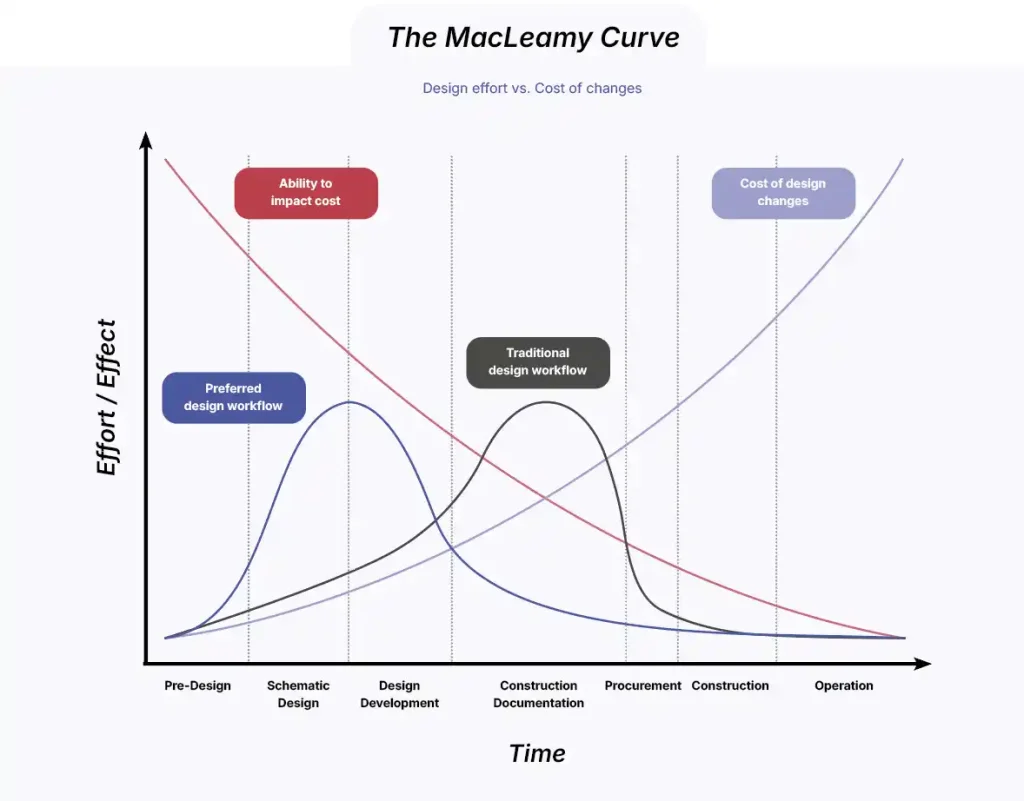
Front-loading (bringing decision-making and analysis earlier into design) has long been known as a solution. The MacLeamy Curve diagram illustrates this well: the earlier a change is made, the cheaper and more impactful it is. But in practice, front-loading hasn’t scaled because it requires a level of coordination, information access, and expertise that traditional tools simply can’t support.
This is where Agentic AI and multi-agent (swarm) systems come in.
What’s Inside the Paper
1. The Case for Change
The first chapters outline why AEC must rethink established processes. Fragmented information, inconsistent quality control, and siloed teams all contribute to costly downstream surprises. The paper cites that large projects often run 20% longer than planned and 80% over budget — an untenable trend that demands a structural shift in how decisions are made.
2. From Reactive to Proactive Workflows
We break down how front-loading transforms project certainty by addressing issues before they snowball. The paper summarises clear benefits:
- Reduced rework thanks to early error detection
- Cost savings, with design errors alone adding ~14% to total project cost
- More efficient schedules through early coordination
- Environmental gains, especially in embodied carbon decisions
3. Introducing Agentic AI & Swarm Agents
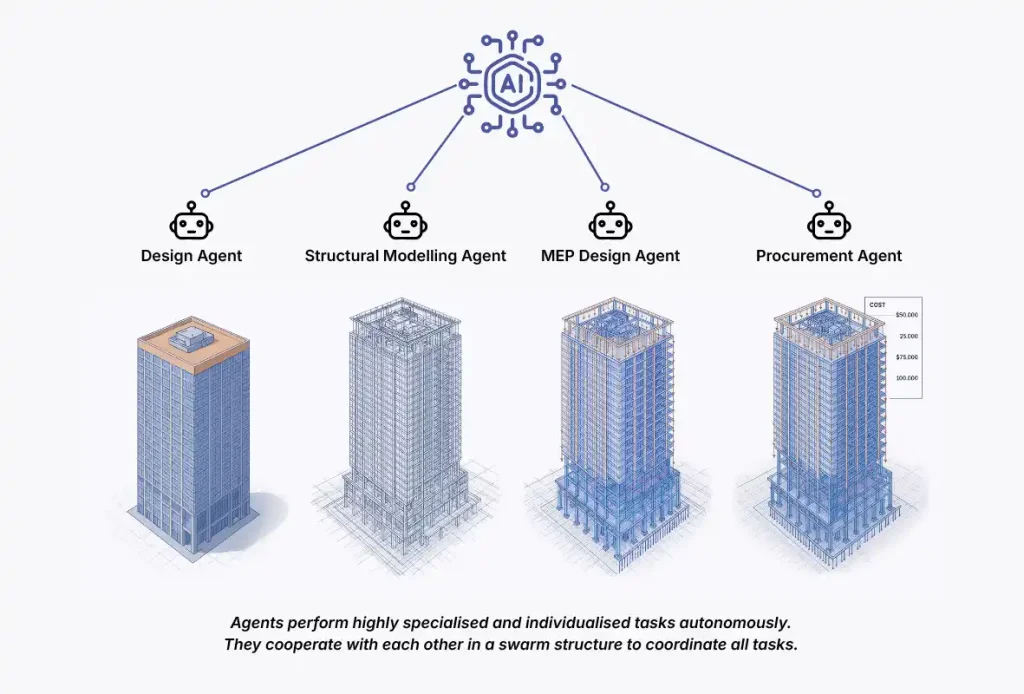
A major section of the paper introduces Agentic AI — autonomous systems that don’t just respond to prompts but can plan, reason, coordinate, and act. When many domain-specific agents work together, they form a swarm capable of parallel analysis that mirrors an interdisciplinary design team — only vastly faster.
4. How Tektome Enables Front-Loading
The white paper highlights two Tektome products that make all this possible:
KnowledgeBuilder
A tool that unlocks lessons from past projects (drawings, BIM, reports, change orders, “lessons learned” logs) and transforms them into accessible, structured knowledge. This becomes the shared memory for both humans and AI agents.
ReqManager
An AI-powered cockpit for managing requirements: codes, client needs, sustainability criteria, internal standards. It acts as a live rulebook, enabling agents to validate decisions in real time.
Together, these tools form the “intelligence infrastructure” needed for multi-agent systems to operate effectively (page 12).
5. Cross-Company Agent Collaboration
One of the most forward-looking sections (pages 17–19) examines how firms across the sector could share specialised agents through open standards – similar to how Google’s Agent2Agent (A2A) protocol allows AI systems to talk to each other. Imagine a design agent automatically engaging an external structural analysis agent or compliance agent within minutes.
This collaborative model opens opportunities for entirely new industry ecosystems.
6. A Proactive, AI-Driven Future
The concluding pages paint a picture of where the industry is heading: fewer change orders, tighter budgets, empowered teams, and buildings shaped by a coordinated digital swarm rather than fragmented manual workflows.
As the paper states, this is not automation replacing designers – it’s automation amplifying them.
Why This Matters for AEC Right Now
Our sector can no longer afford the “fix it later” mindset. AI-augmented front-loading provides a practical pathway to improve design quality, reduce stress on teams, and safeguard profitability — without stripping away the creativity at the heart of architecture and engineering.
This white paper gives leaders, BIM managers, DX specialists, and design teams a glimpse of what’s already possible today — and what’s coming next.
Download the White Paper
You can access the full Front-Loading Construction white paper here.
If you’re interested in exploring how KnowledgeBuilder, ReqManager, or multi-agent AI could support your upcoming projects, we’d love to chat. Reach us at info@tektome.com.