
Last week took us to Paris for RELEASE [AEC] on Tuesday, and to Tokyo for Archi Future 2026 on Friday. Two very different events, nearly 10,000 kilometres apart, that ended up asking the same question.
A bigger second edition in Paris.
RELEASE [AEC] began last November at Paris Pleyel as a day for the AEC community to see where its technology is heading. Instead of conventional stands, companies demonstrate live from demo pods throughout the day, to an audience of AEC professionals whose registrations are vetted. We demonstrated at that first edition, and on 20 October we were back for the second.
It has grown a lot in a year. The event moved to the Cité des Sciences et de l’Industrie at La Villette, with more companies demonstrating and speakers from practices including Henning Larsen, KPF, Benoy and Sweco Architects. Thomas Heatherwick closed the day, ahead of Architizer’s Vision Awards celebration. Much of the programme was about AI in design, and several talks looked at how a practice turns early experiments into methods it can scale. Our part of that conversation was the review that comes before sign-off.
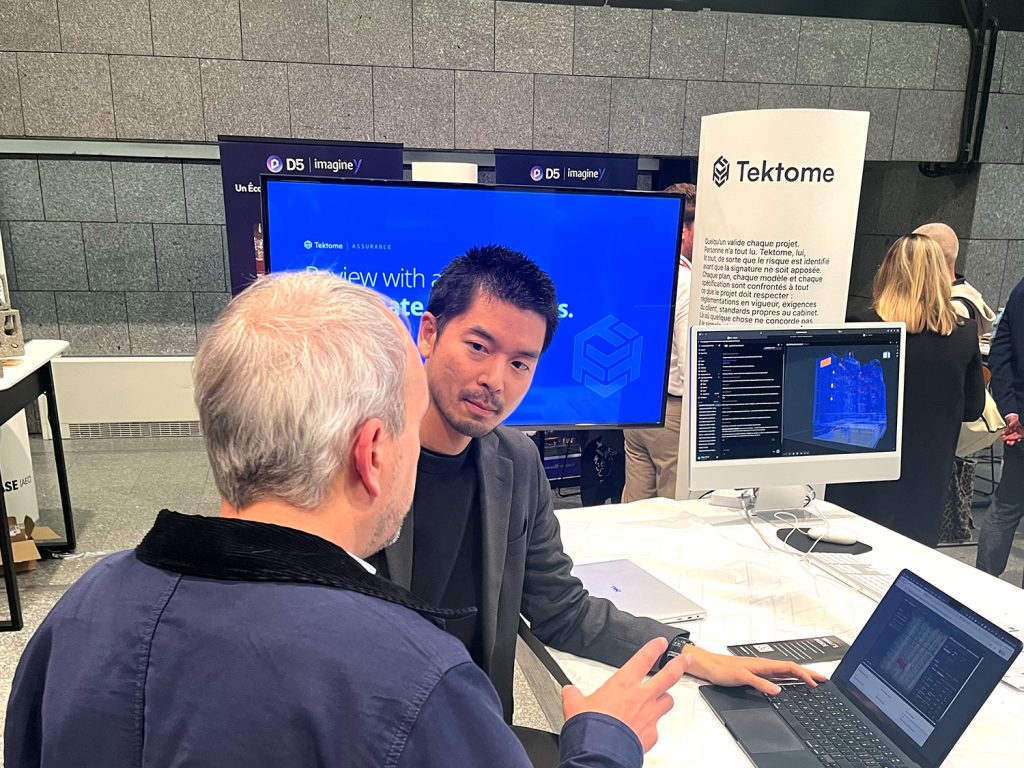
Familiar faces, and a year of progress.
A second edition means familiar faces. It was great to catch up with people we first met at Pleyel and others we have stayed in touch with since, and to show them how far things have come. Last year we showed how a project’s requirements and a firm’s past project knowledge could be brought together and searched. This year, those same pieces were working together inside a complete review, from the first requirement through to sign-off.
The bigger event brought plenty of new faces too, and it was a pleasure to meet so many people for the first time. For many of them it was a first look at Tektome, and the film on our screen made a good place to start.
One complete review, on one screen.
The film follows a review of a sample residential scheme from start to finish, and the team walked visitors through it step by step. It begins with what the scheme has to satisfy. Building regulations and the firm’s own standards are installed as modules. The project’s own requirements are then drawn from the brief, the exchange information requirements, the fire strategy and the meeting minutes, each linked back to the passage it came from.
From there, an agent works through every requirement against the drawings and the model, measuring or calculating wherever a value is not stated, and gives each one a verdict of pass, fail or unsure, with the evidence alongside. Issues reach the people who fix them as a report, a one-page summary and BCF issues for the model, and every new revision is reviewed against whatever is still open. Marked-up drawings, model views, dashboards and reports all come from the same set of information, with full traceability behind every requirement. By sign-off, the record shows what passed, what failed and what nobody has reviewed yet.
It was made to be followed without sound on a busy stand, so you can watch it here just as visitors saw it.
Tokyo, at the digital tipping point.
Three days later, Archi Future 2026 opened at TFT Hall in Ariake, Tokyo, a day of lectures, technical forums and exhibitions for people who design and build. We were back as a Platinum Sponsor, with a stand and a talk in the Technical Forum.
This year’s theme was the digital tipping point, and the keynote took a long view, asking how cities, infrastructure and the places people live can stay resilient through a shrinking population and a changing climate. It also invited the audience to see buildings as vast bodies of information about land, weather, use and society, as well as physical structures.
Across the other sessions, one thread kept returning. How can AI carry what a firm already knows into its next piece of work? That meant turning drawings, models and past project data into knowledge that can be compared and analysed, letting AI handle the volume while people make the judgements, and making new tools stick across existing processes and silos.
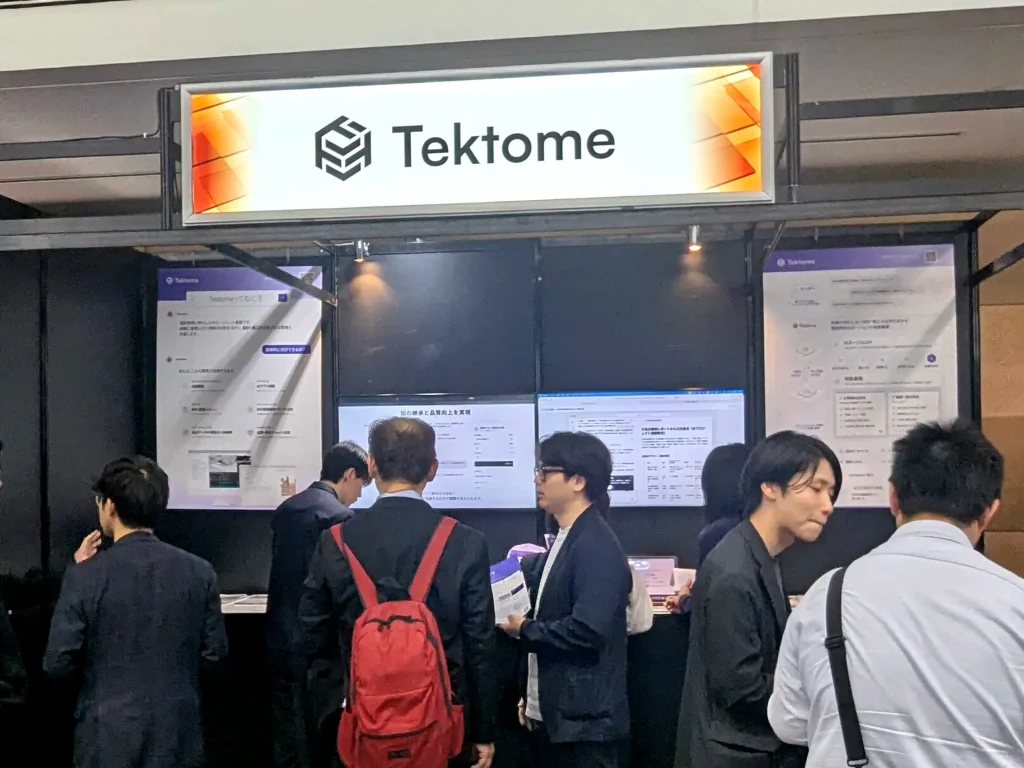
At our stand, the questions got specific.
On stand E-2, our Tokyo team showed Tektome’s AI agents taking on research and reviews from plain-language requests, drawing on an intelligence base that keeps drawings, regulations and past decisions as the organisation’s own knowledge. The demonstrations ranged from regulations and local ordinance research to drawing and model review, reviews against past defects, and structuring drawing and document data.
The question we heard most was how far AI can work with drawings and BIM, usually with a real task in mind, from consistency across a drawing set to MEP model review and learning from past defects. Data was the other big theme. People told us that getting data ready for AI is a job in itself, and asked how much data it takes to start and how to keep their most experienced people’s tacit knowledge where everyone can use it. Others already use general-purpose AI but want better accuracy, tighter security and a proper fit with how they work.
What struck the team most was how many visitors had moved past the abstract question of what AI can do, and were working out how to connect their own drawings, models and past knowledge to it.
Keep, level, advance.
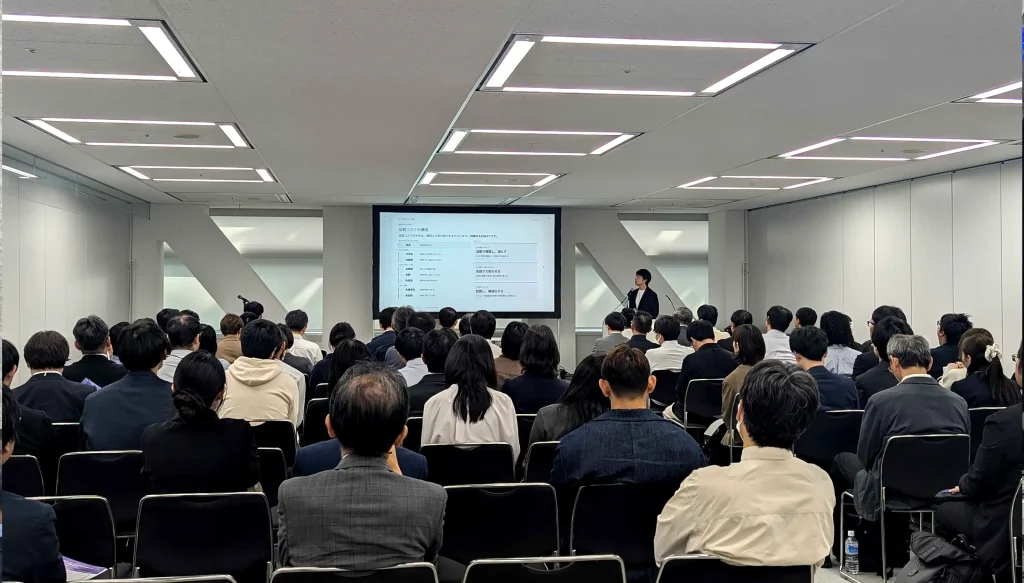
In the Technical Forum, our CEO Naoki Kitamura spoke about AI and quality management, and how to stop quality depending on any one person. Projects keep adding to what has to be reviewed, while experienced people have less time to pass on what they know. If the reasoning behind past rework and defects is not kept, the same problems can return on the next project.
He set out Tektome’s approach as three steps, 残す, 均す and 挑む, which translate roughly as keep, level and advance.
Three steps
- Keep. Record how experienced people make their judgements, with the criteria and evidence behind them, as the organisation’s own knowledge.
- Level. Let AI put that knowledge to work so the right reviews happen whoever is on the job. AI covers the breadth, people make the significant calls, and quality stops resting on experience alone.
- Advance. With routine reviews and research handled by AI, turn people’s attention to concept work, conversation and creating new value.
Some visitors came to the stand after the talk. One told us that passing on knowledge now felt like something they had to tackle, and another had not realised how far AI could go with regulatory research. Those conversations soon turned to their own projects.
Two cities, one question.
The two events came at it from different directions. In Paris, several talks asked how a practice gets from early experiments with AI to methods everyone can use. In Tokyo, the focus was on how a firm’s accumulated knowledge becomes useful through AI. Underneath, both were asking how AI works inside a practice from day to day, and what it leaves behind.
That is the question we build for. Little by little, Tektome keeps the questions, drawings, cases, requirements and decisions that everyday work produces, so each review starts from what the firm already knows and leaves a record the next one can build on.
Key takeaway
In Paris and Tokyo alike, the interest has moved on from what AI can do to how it works inside a practice. The firms that benefit most will be the ones that keep their judgement, and the evidence behind it, where the next project can use it.
Thank you to everyone who came to see us at Stand 6 in Paris and stand E-2 in Tokyo, and to everyone who joined Naoki’s session in the Technical Forum.
Missed us in Paris or Tokyo?
Contact us directly and we will show you everything we demonstrated, from the complete review on our Paris screen to the AI agents we showed in Tokyo, on a sample scheme or a problem from your own work.
Book a demo