Building Information Modeling (BIM) has revolutionised how we design and document buildings, but our methods for quality checking and compliance haven’t caught up. Most project teams still rely on painstaking manual reviews of models and drawings to ensure everything meets standards and codes. This old-school approach is causing headaches across the Architecture, Engineering, and Construction (AEC) industry. In this article, we’ll unpack why the status quo of BIM model checking is labour-intensive, error-prone, and unsustainable, and then explore how a smarter, AI-powered solution could change the game.
Why Manual BIM Model Checking Is Broken
Here are the biggest problems with the way we verify models and compliance today:
- Time-Consuming & Labour-Intensive: Studies have found that “manual compliance checking is time-consuming, costly and error-prone”. In other words, we burn a lot of effort on something a computer could do faster.
- Prone to Human Error: When humans are doing all the checking, mistakes are inevitable. Fatigue sets in, details slip through the cracks, or someone misreads a spec. One scientific review noted that traditional manual inspection methods are “error-prone” and inefficient.
- Chaotic with Frequent Design Changes: Modern projects are constantly evolving. It’s not unusual for a design to go through dozens of revisions (50+ changes on a typical job isn’t unheard of). Manually re-checking the entire model after each update becomes chaotic – it’s a scramble to see what changed and what needs re-verification.
- Ambiguous, Inconsistent Interpretations: Two different reviewers might not interpret the rules the same way. Building codes are massive and sometimes open to interpretation, so one checker might flag an issue that another would ignore. A 2023 study noted that as BIM models get complex, manual reviews tend to result in “ambiguity and inconsistency in design assessments”.
- Doesn’t Scale for Big Projects: BIM was supposed to help us handle bigger, more complex projects, and it has – but our manual checking methods haven’t scaled up. A small building might be manageable to review by hand, but a large hospital or airport terminal with millions of BIM elements? Forget it. Manual QA doesn’t scale – you would need an army of experts and endless hours to thoroughly check a huge model, which isn’t practical.
- Reliant on Individual Expertise: Today’s model checking process often boils down to “who’s the expert on this?” If you have a seasoned BIM manager or code specialist on the team, great – a lot of compliance relies on their personal knowledge. But that makes it hard to ensure consistency across different teams or projects.
- Limited Help from Current Tools: You might be thinking, “Aren’t there software tools for this?” Yes – there are some tools that help by automating some clash detection and rule compliance checks. But these tools have their own issues. Setting up these tools can be complex and requires specialised skills.
In short, the way we check BIM models today is ripe for improvement. It drains time, budget, and morale. It introduces uncertainty when we can least afford it – nobody wants surprises in a code review or during construction. So what’s the alternative? Let’s imagine a better way.
A Smarter Way: Automating BIM Checks with AI
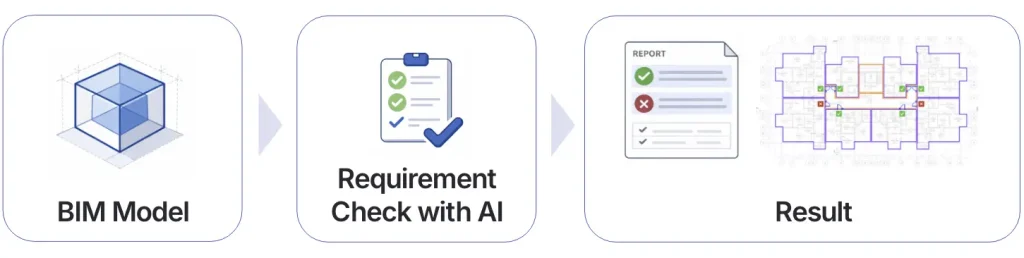
Imagine if verifying a BIM model were as quick and reliable as running a spell-check in Word. Why can’t we have a “code-check” button for BIM? The good news is that we’re getting close. Advances in BIM software and AI are enabling a new generation of tools that automate compliance checking and significantly reduce manual effort.
In an ideal world (which is closer than you might think), BIM model QA works like this: the computer handles the tedious work, and humans supervise.
The impact is huge. Results are consistent no matter who runs the check, because the rules are applied the same way every time. Ambiguity is reduced, with humans focusing only on genuine grey areas instead of missing issues altogether. Automated checks also scale effortlessly – whether a model has 100 elements or 100,000, it’s the same push-button process. Complexity stops being intimidating when the heavy lifting is done by a machine built to crunch massive datasets.
We’re already seeing early signs of this future. Researchers and tech companies are developing tools for Automated Code Compliance (ACC) and rule-based model checking. In fact, automated compliance is now a major BIM trend, with several countries piloting e-permitting systems where BIM models are automatically checked against building regulations.
Real World Example
To truly understand how much time and effort this method can save, let’s walk through a real-world example.
Let’s say you’re working on a hospital project and need to verify whether there are any rooms near the EPS (Electrical Power Shaft) where wet floor cleaning might be expected. Today, this would typically involve manually checking the floor plans or navigating through a massive BIM model, cross-referencing room types, finishes, and adjacent zones, a process that could take hours.
In the world with AI assistance, it would look more like this:
1. You simply ask the AI:
“Check if there are any rooms around the EPS where wet floor cleaning might be performed.”
2. The AI gets to work:
SmartCheck automatically reads the BIM model, understands your intent, and identifies all rooms adjacent to the EPS. It then cross-references room names, typical use cases, and materials, for example, spotting that a garbage storage room nearby might involve water cleaning.
3. A report is generated instantly:
You get a structured result showing relevant rooms, how close they are to the EPS, and whether they match the criteria. No scripting, no coding, no manual filters – just one natural language prompt and actionable results.
This natural, language-based checking experience is what makes this method so powerful. It’s designed to help architects and QA teams move faster, catch more, and spend less time digging through drawings and models.
Tektome’s Solution on the Horizon
At Tektome, we’re as frustrated with today’s manual QA grind as you are – and we’re doing something about it. We are building a next-generation BIM checking tool designed to solve exactly the pain points we outlined above. (We won’t spill all the beans just yet, but here’s a sneak peek 😉.)
Our approach leverages AI and smart automation to make model checking almost effortless for you. Instead of writing complex rules or spending days, you’ll be able to check a BIM model against a specific list of requirements with just a few clicks.
Most importantly, the tool we’re developing aims to free you up to focus on design and big-picture problem solving, rather than clicking through endless model views hunting for issues. The AI will do the hunt; you just make the decisions on how to address the findings.
Sounds exciting? We think so too. It’s the “better way” we’ve all been waiting for in BIM.
The Bottom Line
Manual BIM model checking is broken, but we don’t have to live with it. A new, smarter approach is around the corner – one that can save time, reduce errors, and make the whole design process more efficient and enjoyable for everyone involved. At Tektome, we’re hard at work making this vision a reality.
Leave us your contact details below to get notified as soon as our automated BIM compliance tool is ready for launch.