
What’s changing from 24 July
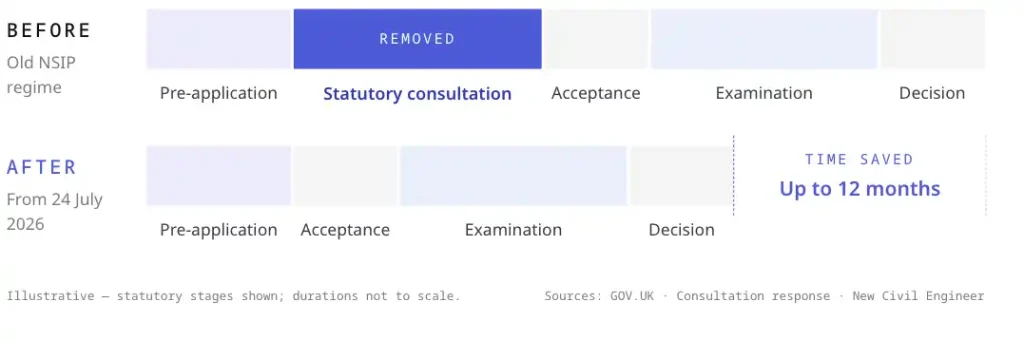
On 3 July 2026 the government confirmed the biggest overhaul of the Nationally Significant Infrastructure Projects (NSIP) regime since it began. From 24 July, the statutory requirement to run pre-application consultation is removed for major projects (energy, water, transport, data centres and more), a change ministers expect to cut up to 12 months from timelines and save industry around £1 billion this Parliament (GOV.UK; consultation response; New Civil Engineer).
The speed is real and welcome. But it changes the shape of the work. Mandatory pre-application consultation was slow partly because it was iterative: it forced engagement, exposed weaknesses in an application, and gave developers a structured chance to fix them before formal submission. In its place, developers get earlier technical support from the Planning Inspectorate (PINS) before they submit, and issue-focused examinations that concentrate scrutiny on the points that genuinely matter rather than working through everything (LexisNexis; BCLP). That’s leaner, but PINS technical guidance is targeted advice, not the open, iterative consultation loop it replaces, so there is far less structured feedback to catch weaknesses before you submit.
Up to 12 months faster
Removing the statutory pre-application consultation shortens the route from proposal to decision for major projects.
What’s being traded away
It’s worth being fair about what’s being traded here. Pre-application consultation wasn’t only a quality-control mechanism: it was also how affected communities were engaged and local consent was built, and stripping out the mandatory version has real implications for legitimacy that sit outside this piece’s scope. Our focus is narrower and operational: what it means for the teams who have to get an application through.
The bar just moved to right first time
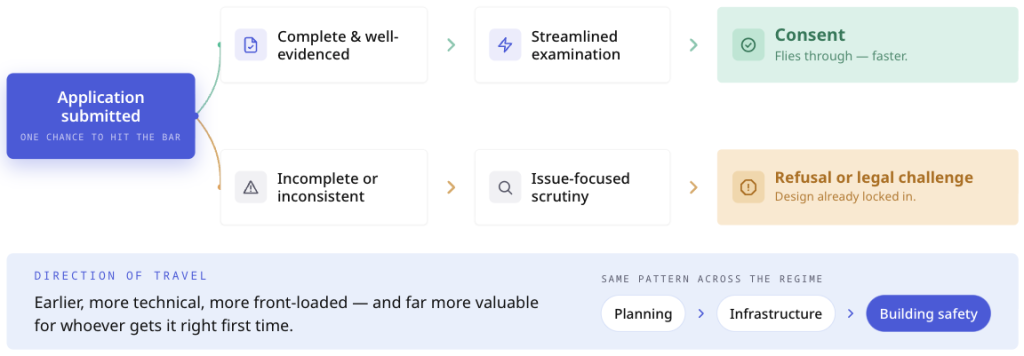
On that front, the practical bar moves. With fewer rounds to catch and correct problems, the application has to arrive complete, high-quality and technically sound, much closer to one-shot. And the reform’s headline benefit, speed, is conditional on hitting that bar. A polished, well-evidenced application flies through a streamlined examination. An incomplete or inconsistent one meets issue-focused scrutiny, risks refusal, or invites a legal challenge that the same reforms have made quicker to bring, all with the design already locked in.
And the reform introduces a second, quieter risk. Because design, surveys and geotechnical work now push ahead of the structured stakeholder engagement that used to run alongside them, developers commit to a design earlier and with more exposure. Independent risk analysts are already flagging the consequence: a higher chance of late, costly design iterations and land-access disputes once feedback finally arrives, now compressed into the examination window (Geomechanics.io). Removing the consultation stage doesn’t remove the problems it used to surface; it defers them to a more expensive moment.
A complexity problem, not an effort problem
It helps to be concrete about the scale involved, because this is fundamentally a complexity problem. A Development Consent Order application for a nationally significant project can run to thousands of pages and carry many thousands of individual requirements, spread across scores of documents (the environmental statement, design principles, the draft DCO itself) that must stay consistent with one another, with the evolving design, and with the standards and policy they cite. The Planning Inspectorate then examines the application against all of it. At that scale the failure modes are rarely dramatic: a requirement in one document that contradicts another, a clause the client reads differently from the design team, an obligation quietly lost between revisions. Consultation used to be one of the places those slips got caught. Take it away and the complexity is unchanged: only the opportunities to catch its consequences are fewer.
What one-shot quality actually requires
Delivering one-shot quality reliably is not an effort problem; it’s a systems problem. It needs structured requirements and evidence so nothing is assessed on missing information; automated checking of the model and documents with the reasoning shown, so issues surface early rather than in examination; output that is consistent and auditable across every engineer and every project; and the ability to forecast, from past consented schemes, the impact of a design decision before it’s committed.
That is precisely what a general-purpose LLM can’t give you. It doesn’t hold your project context, its output is unpredictable, and it can’t be audited: the opposite of what a submission demands. What the moment calls for is a platform built on your own project context and data, one that structures requirements and evidence, validates them against the design itself, and makes the output consistent and dependable enough to build a submission on. And it compounds: learning from what has been consented before so the next application starts further ahead.
Requirements management is the heart of it
The industry is already moving this way, which is worth saying plainly. Major infrastructure consultancies are building and deploying AI tools that read vast document sets and elicit, verify and categorise requirements far faster than manual review, flagging incomplete or contradictory requirements for a specialist team, and supporting continuous, “progressive” assurance with a clear audit trail across the project lifecycle. The value of the category is proven; the question is how far a platform takes it.
Tektome works in the same spirit but goes further in two ways that matter specifically for one-shot delivery. First, it doesn’t stop at text: each requirement is linked to the 3D/BIM model and its evidence, so “is this requirement actually met?” is answered against the design itself, not just cross-referenced between documents. Second, it supports deep research across your own historic projects and company know-how, so the platform doesn’t merely verify today’s requirements, it surfaces what comparable schemes learned, flags the issues that recurred, and compounds with every project rather than starting cold each time. Throughout, engineers stay in the loop: the platform does the monotonous, error-prone verification at scale, and people apply the judgement.
The stakes
The reform takes away the safety net of iteration and moves risk forward, onto your submission. The firms that build the system to deliver right first time will capture the year of saved time. The firms that don’t will discover, faster than before, that the design was locked in before it was ready.
This is where Tektome earns its place, as risk mitigation and proactive resolution, not just speed. Getting it right first time comes down to four things, and it supports each:
- Know and meet every requirement. It surfaces them all, not just the written rules but the ones buried in manuals, past lessons and engineers’ tacit know-how, and makes what’s still unverified visible by severity, so nothing is missed before submission.
- Don’t repeat past mistakes. It brings the lessons of comparable consented schemes onto the current one, flagging recurring issues before they are designed in again.
- Increase quality with knowledge, not headcount. It applies your accumulated company know-how to check the design is right, not merely complete.
- Review earlier, in the model. It checks the 3D/BIM model against the requirements while the design is still fluid, so problems surface when they are cheap to fix, not after submission, with engineers in the loop throughout.
The effect is that issues are caught and resolved proactively, while the design can still change, rather than after it is locked in. That is how you mitigate the risk and bank the time it promises. If NSIP or DCO delivery is on your horizon, speak with the Tektome team about making one-shot quality a repeatable system.