Building regulations span multiple documents and layers of legislation,
each with its own conditions and cross-references. Tektome Regulations
Research makes that web of rules easy to navigate — ask a question in
plain language and get a clear, source-cited answer.
Trusted by architects across the UK, from sole practitioners to studio teams.
Tektome Regulations Research · Residential Project in London
What is the required minimum height of horizontal DPC in external wall?
YOU
Based on Approved Document C, paragraph 5.5(b) the minimum height for a horizontal Damp Proof Course (DPC) in an external masonry wall for this residential project is 150mm above the level of the adjoining ground.
Source highlighted in document
"If the wall is an external wall, the damp-proof course should be at least 150mm above the level of the adjoining ground (see Diagram 8), unless the design is such that a part of the building will protect the wall."
Approved Document C, paragraph 5.5(b)
TEKTOME
What material a Damp Proof Course (DPC) should be?
YOU
Bituminous material, polyethylene, engineering bricks, slates in cement mortar, or any other material preventing moisture passage (based on Approved Document C, Section 5, Technical Solution paragraph 5.5(a)).
TEKTOME
Ask a follow-up question…
Key Features
Everything you need to research with confidence.
From the first applicability check to the final source-cited answer, Regulations Research keeps the full web of rules within reach.
Feature 01
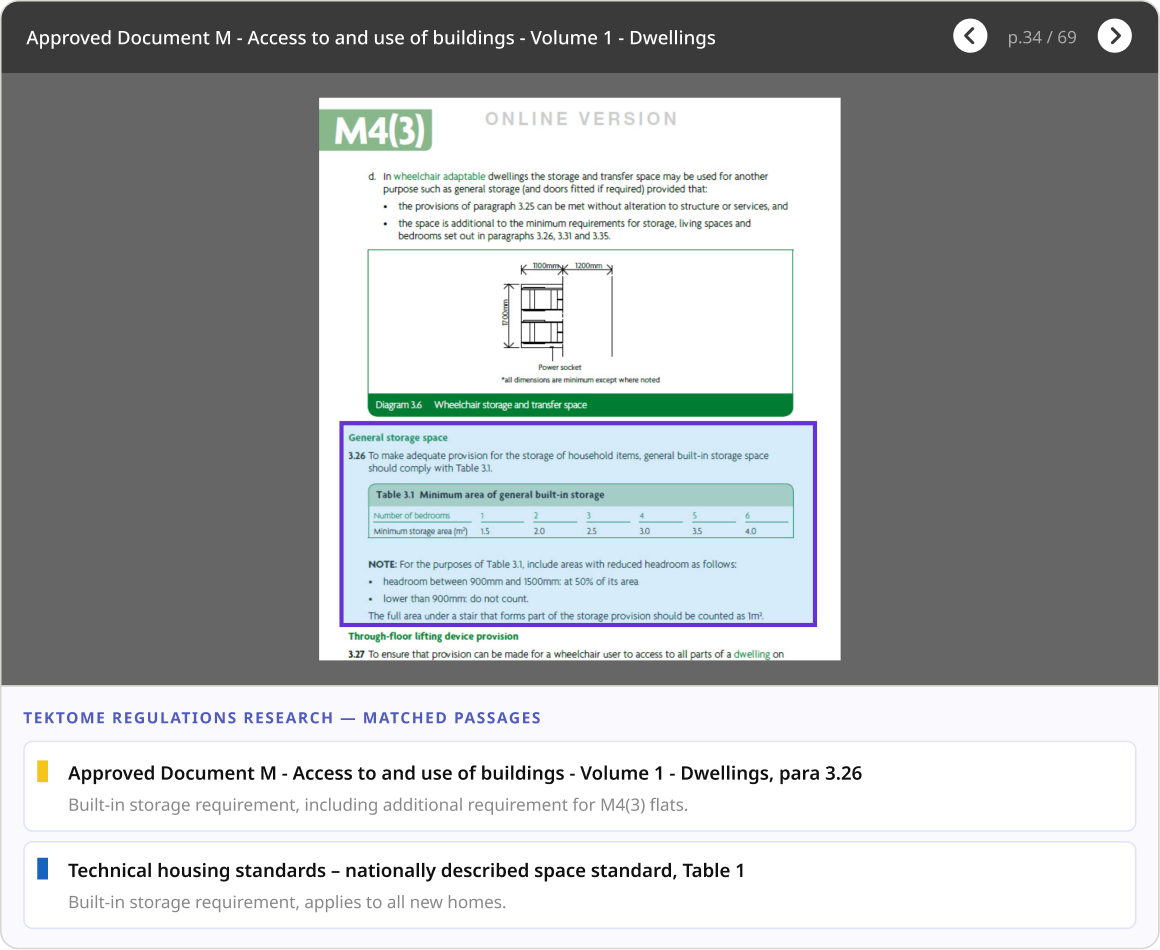
Every answer traced back to the source.
See the exact passage highlighted inside the original document, alongside every other clause that matches your question — so you can verify the answer, not just trust it.
Highlighted source text in the live document viewer.
Matched passages ranked across every relevant regulation.
Feature 02
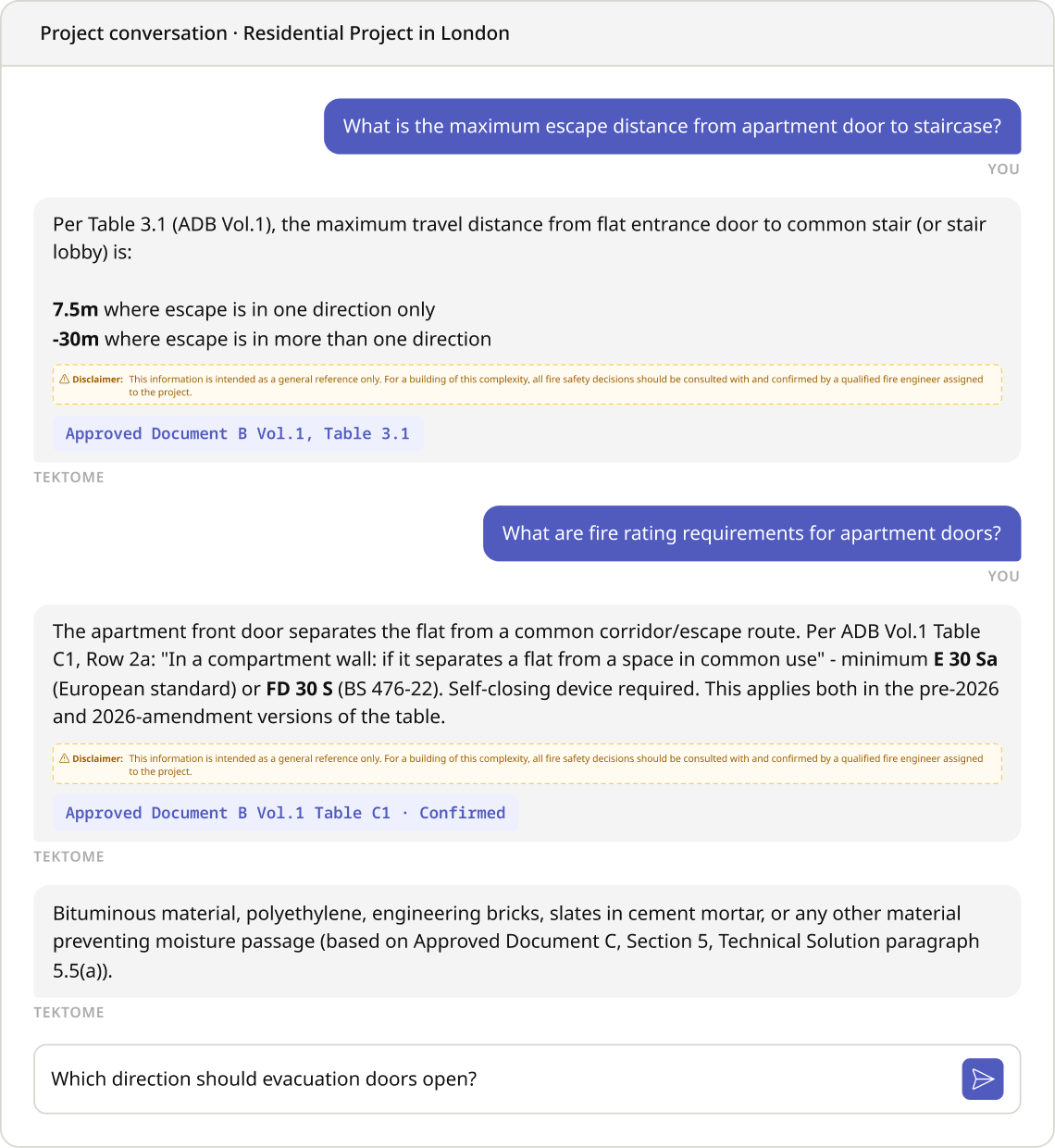
A project conversation that remembers the context.
Ask follow-up questions in plain language and get answers grounded in the specific documents that apply — each one cited, and flagged where a qualified engineer should confirm.
Source citation on every response.
Clear disclaimers where engineering judgement is required.
Feature 03
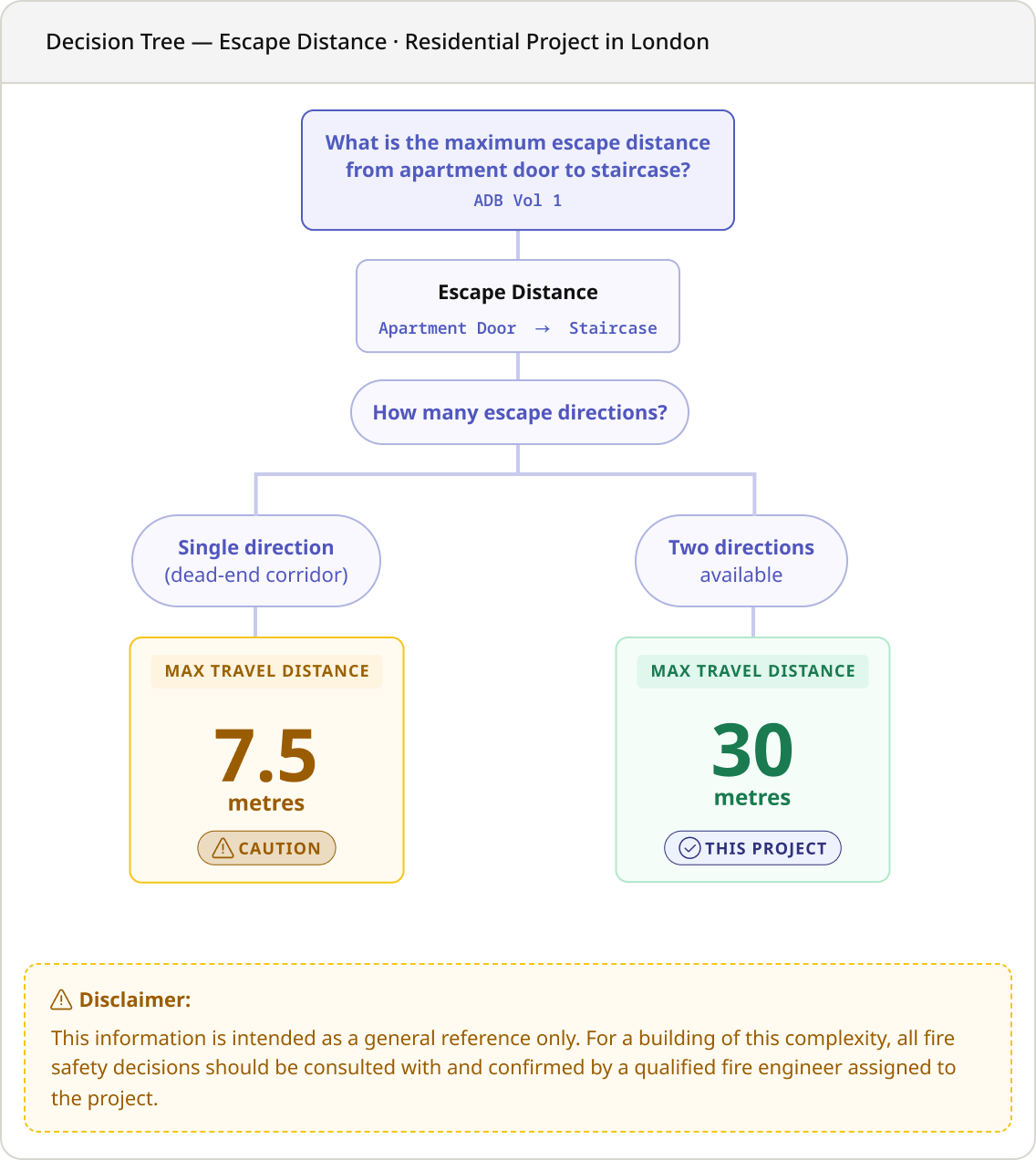
See how a rule branches for your project.
Conditional requirements are mapped into a decision tree, so you can follow the logic to the value that applies to your project — and see the path you didn't take.
Visual decision paths for conditional requirements.
The applicable outcome highlighted for your project.
Feature 04
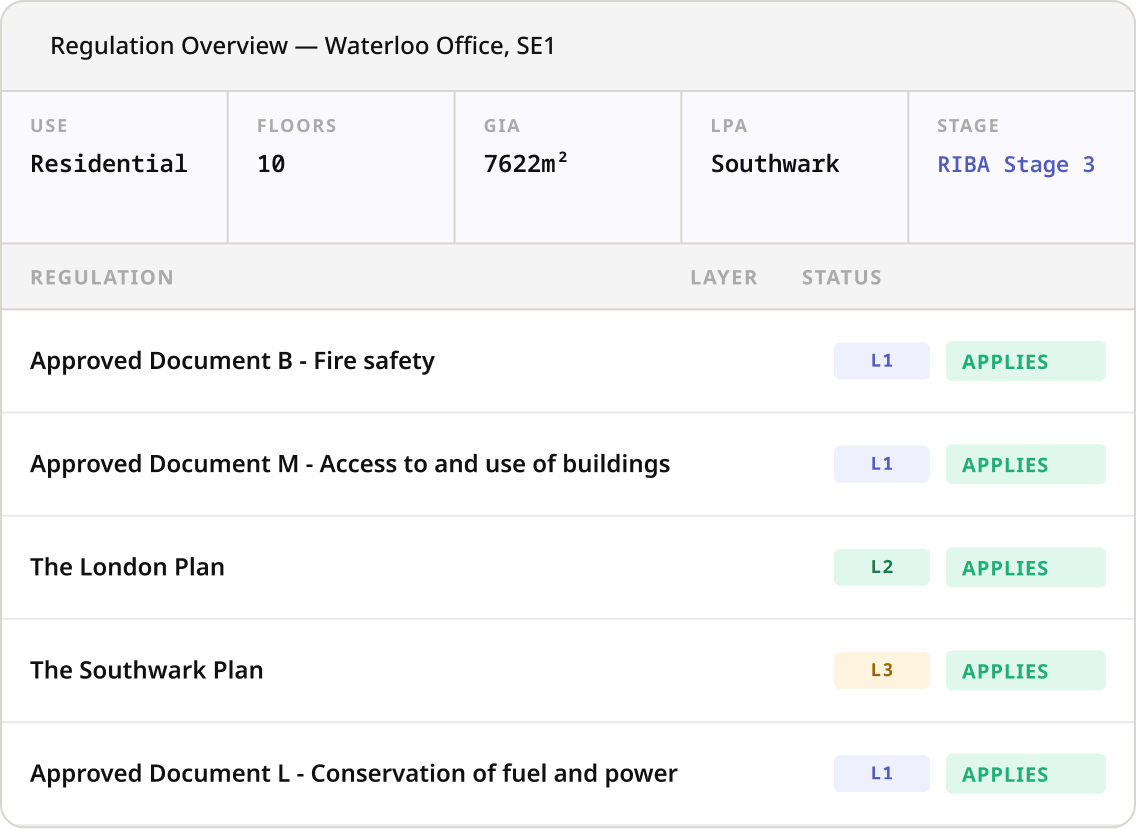
Know which regulations apply before you start.
Enter your project's use, scale, and location and get an overview of every regulation that applies — national, regional, and local — organised by layer and status.
Applicability mapped from project parameters.
National, London, and borough layers in one view.
How it works
From project brief to regulatory clarity in four steps
01
Enter project details
Type your project's use, location, number of floors, gross area, and any known constraints, in free text with no forms to fill.
02
Start your research conversation
Ask your first question in plain language. Tektome Regulations Research understands the context of your project and responds with cited, source-referenced answers.
03
Interrogate the reasoning
Each answer shows the source clause highlighted in the relevant document, and a decision tree that lays out how the conclusion was reached, including what is confirmed, provisional, or still needs verification.
04
Continue the conversation as the project evolves
As the design evolves, bring new questions back to Tektome Regulations Research. Ask what a change means for your regulatory position, and pick up the conversation in context where you left off.
Use Cases
Built for the layered reality of regulatory research.
Whether you're working through a mixed-use scheme, a listed building consent, or a change of use, these are the scenarios where regulations span multiple layers and documents — and where having a proper research tool makes the difference.
Stage 1 — Feasibility
Starting a new project: what regulations actually apply?
Residential · Bristol · 12 units · 4 storeys
Enter your project type, location, scale, and use. Tektome Regulations Research generates a complete list of applicable regulations — from national Approved Documents to Bristol-specific planning policy — in under a minute.
Example output
"18 regulations identified. 12 confirmed applicable. 4 conditional on design stage. 2 require verification with Bristol City Council."
Stage 3 — Developed Design
The floor plan just changed. What do you need to re-check?
Room area: 48m² → 72m² — ask what's changed
When a room grows from 48m² to 72m², ask Tektome Regulations Research what that means for your project. It will walk you through which obligations may now apply and why, with the relevant clauses cited.
Example query
"Room 4 has grown from 48m² to 72m². Does this change anything under Part F or Part B for ventilation and fire safety?"
Pre-application / Planning
Preparing for a pre-app meeting with confidence.
Conservation area · Listed building · Hackney
Apply the Listed Building & Conservation Area template. Get a structured breakdown of what consent is needed, what evidence is required, and which local policies apply, ready to present.
Example query
"What does Hackney's Article 4 direction restrict in this conservation area, and what documentation is typically required for a pre-app?"
Second Opinion
Sanity-checking your own judgment before submission.
Risk hedge · 5-minute check
You're 90% confident your fire strategy is sound. Ask Tektome Regulations Research to check. 9 times out of 10 it confirms what you already know, and once in a while, it catches something you missed.
Example query
"Is a fire suppression system required for this building? Confirm my fire strategy approach is consistent with ADB Volume 2."
Free Trial
Apply for a free trial.
See Tektome Regulations Research on a sample project. Tell us a little about your team and we'll set you up with early access.
Search regulations in natural language
Grounded in the codes that apply to you
No commitment, no setup required
Book a 30-minute demo
Step 3 of 3
Pick a time with Henry
Thirty minutes, and you will get a calendar invite straight away.
Your meeting is booked.
A calendar invite is on its way to your inbox.
Henry will bring a prepared sample project, so there is nothing for you to set up.
Need to change it? Reply to the invite and we will sort it out.
Step 3 of 3
Pick a time with Henry
Thirty minutes, and you will get a calendar invite straight away.
Your meeting is booked.
A calendar invite is on its way to your inbox.
Henry will bring a prepared sample project, so there is nothing for you to set up.
Need to change it? Reply to the invite and we will sort it out.